How to Test Ghost Image Angle in the Camera View Zone for ECE R43 Automotive Glass Certification
Sep 20, 2026
Beijing, China Sep 20, 2026 (Issuewire.com) - Distorted vision in automotive windscreens creates severe safety risks, often causing driver misjudgments that can lead to hazardous road incidents. Modern vehicles rely heavily on advanced driver-assistance systems (ADAS) and head-up displays (HUD), making optical clarity inside the camera view zone critical. As regulatory bodies enforce stricter limits, glass manufacturers must adopt precision equipment to evaluate optical performance. As a Reliable Service Provider of Testing Ghost Image Angle in the Camera View Zone, industry professionals look to advanced testing methods to ensure every batch of automotive safety glass meets rigid international standards.
Understanding Ghost Image Angle and ECE R43 Compliance
Ghost images occur when light refracts through the inner and outer surfaces of laminated windshield glass, producing a secondary overlapping image. Within the critical camera and sensor viewing zones, this optical defect compromises automated braking and lane-keeping systems.
The ECE R43 automotive glass certification mandates strict optical requirements to prevent visual distortions. Compliance demands rigorous evaluation of light transmission, optical distortion, and secondary image separation angles. Testing these parameters guarantees that ADAS cameras receive clear, undistorted visual data from the road ahead.
How to Test Ghost Image Angle in the Camera View Zone
In modern automotive safety glass manufacturing and quality inspection processes, the camera view zone is typically located directly in front of the vehicle's forward-facing binocular or monocular cameras, supporting core driver assistance functions like lane departure warning, automatic emergency braking, and adaptive cruise control. When sunlight or strong road light sources refract and reflect through the inner and outer surfaces of laminated glass, they generate minor secondary overlapping images known as ghost images. If this angle exceeds standard limits, vehicle optical sensors capture false contours, triggering algorithm misjudgments.
Detailed Testing Workflow and Physical Mechanism
- Optical Incidence and Refraction Simulation:Testing systems utilize highly collimated laser light sources, such as 532nm wavelength lasers, to precisely simulate parallel light beams passing through windshields of varying curvatures. Test beams must strike designated camera zone test points at exact perpendicular or standard angles of incidence.
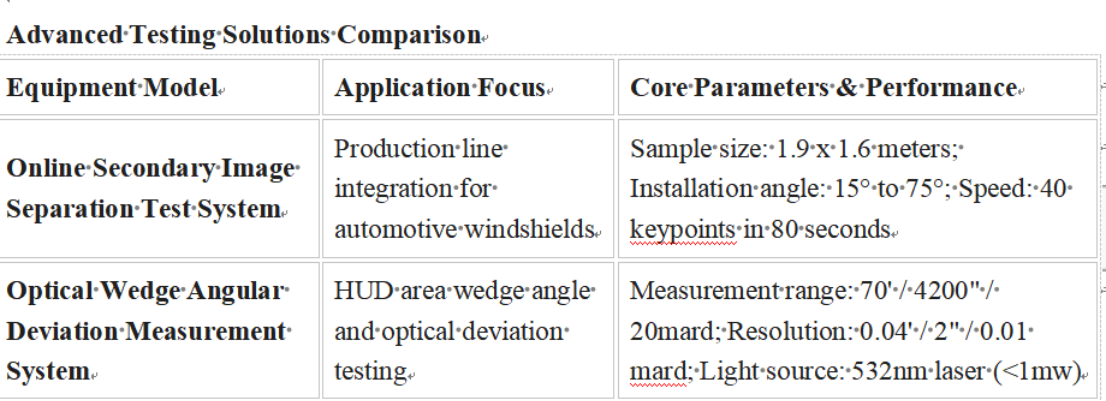
- Multi-Axis Spatial Positioning:Utilizing high-precision electronic control support platforms, automotive glass samples are secured at specified rake angles ranging from 15 degrees to 75 degrees. Due to complex three-dimensional surface curvatures, automated vision systems rely on coordinate calibration to ensure laser emitters and receiving sensors maintain absolute spatial synchronization.
- Primary and Secondary Image Separation Capture:When laser light passes through the PVB interlayer and double-layer glass, primary spots and weak secondary reflection spots project simultaneously onto receiving screens or vision capture matrices. High-resolution cameras perform micrometer-level pixel scanning across this area, precisely capturing the center distance between primary and secondary images.
- Mathematical Modeling and Angle Resolution:Based on trigonometric algorithms, systems convert pixel displacement distances into arcminutes or milliradians. Testing software automatically compares results against preset thresholds, immediately triggering visual-auditory alarms and failing marks if deviation angles exceed standard specifications.
Key Control Elements in Procurement and Validation
- Repeatability Precision:During continuous multi-point testing, single-point measurement repeatability must remain at exceptionally high precision levels--such as tight percentage tolerances when secondary deviation angles fall below strict thresholds--to eliminate environmental micro-vibration interference on optical data.
- Scanning Efficiency and Automation Integration:For high-end production line applications, test systems must support rapid multi-point scanning across large samples, such as 1.9 by 1.6 meters, evaluating dozens of keypoints within compressed timeframes to match modern factory output tempos.
- Data Traceability and Compliance Archiving:Premium test systems must deliver more than raw numbers, incorporating complete test report generation, local data storage, and remote export functionalities to ensure every outgoing batch of automotive safety glass maps seamlessly to international certification technical archives.
Engineering Excellence and Technical Innovation in Glass Inspection
Meeting ECE R43 standards requires robust testing infrastructure backed by certified manufacturing expertise. Established in 2015, Jeffoptics operates as a National High-tech Enterprise holding over 40 authorized patents and more than 10 computer software copyrights.
Procurement specialists evaluating inspection hardware must examine core measurement parameters, sensor stability, and compliance alignment with standards like GB, ECE R43, ASTM, and EN.
Selecting the correct system depends on whether testing occurs off-line in a laboratory or directly on a high-speed manufacturing line. Buyers should verify calibration certificates, software archiving capabilities, and multi-sensor integration potential.
Solution-Based Procurement for Automotive Safety Glass
Integrating reliable optical inspection equipment eliminates compliance risks and enhances production yield for glass manufacturers. Facility managers seeking robust quality control setups can explore integrated technical configurations tailored to specific plant layouts.
For detailed specifications and full-cycle technical support services, visit the official corporate website: https://www.jeffoptech.com/
Source :Beijing Jeffoptics Company Limited
This article was originally published by IssueWire. Read the original article here.
More News








YOUR NEWS, OUR NETWORK.
Do you have Great News you want to tell the world?
Be it updates about your business or your community, you can make sure that it’s heard by submitting your story to our network reaching hundreds of news sites across 6 verticals.